The Bank of Greece assumes the note-issuing privilege
The country’s modern economic and numismatic history is intertwined with that of the Bank of Greece, which was established in 1927 and assumed the exclusive note-issuing privilege.
In 1933, five years after beginning its operations, the Bank inaugurated the first issue of its own banknotes, consisting in paper bills of five denominations that were printed abroad, in the USA and France. Although marked by the distinct aesthetic approach of the two printing factories that produced them, these banknotes as a whole combine Greek cultural heritage with contemporary reality, presenting the Bank as a pillar of Greek economy and as an institution that embodies historical continuity.
-

- The first issue of banknotes by the Bank of Greece. Those of 500 and 5,000 drachmas were printed in the USA in 1932, by the American Bank Note Company. The notes of 50, 100 and 1,000 drachmas were printed in France in 1935,by the Banque de France
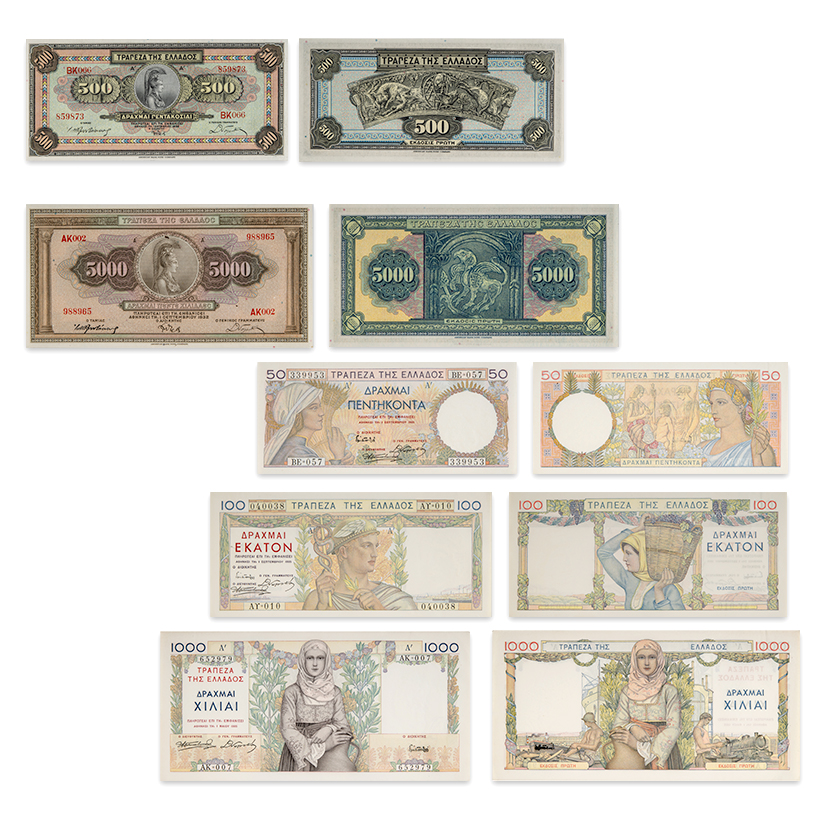
The 500- and 5,000-drachma banknotes were the first to be put into circulation, in 1933. Although printed in New York by the American Bank Note Company (ABNC), they were designed in Athens, bypainter Michael Axelos, Head of the Bank of Greece Banknote Printing Section responsible for designing the banknotes.
-

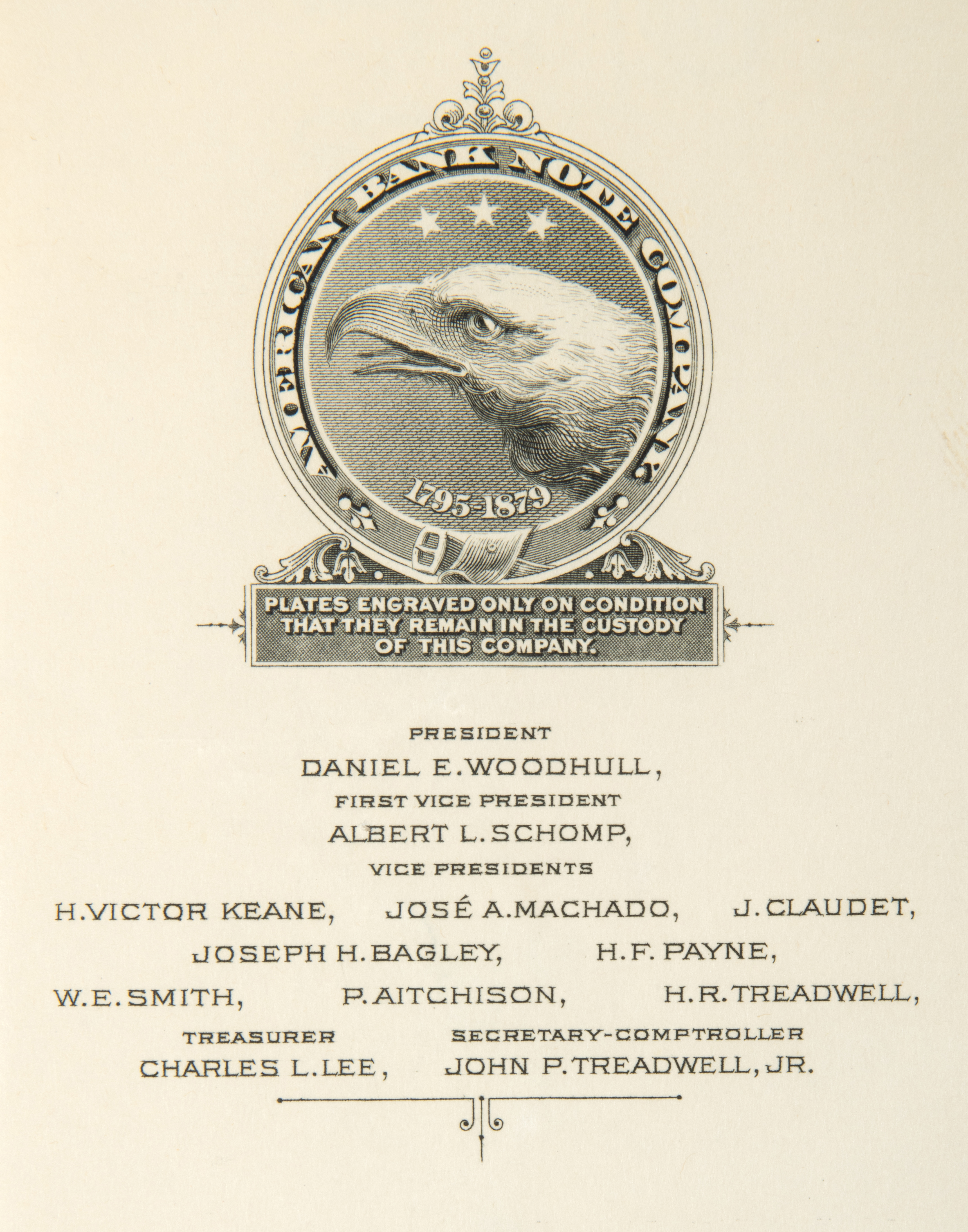
- The logo of the American Bank Note Company. Up until World War II, ABNC was one of the few highly specialised security printing companies that monopolised the market, undertaking the printing of banknotes for most of the countries that issued their own currency. For more than 70 years, it had carried out orders for Greek banknotes by the National Bank of Greece.Collection No. GRIATEA1S12Y7F79 (under processing)
-

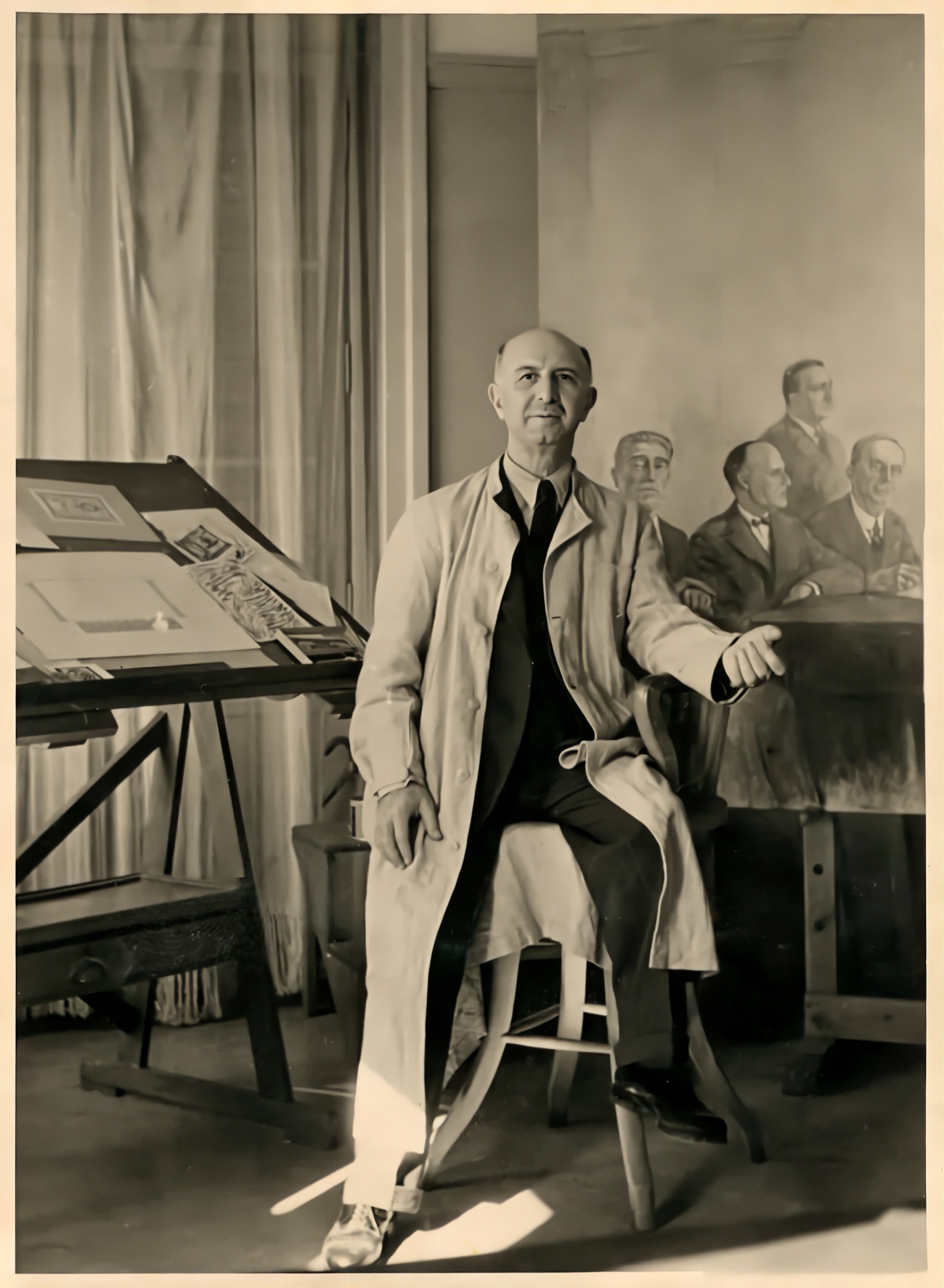
- Painter Michael Axelos,took on the design of Greece’s banknotes from 1918 onwards,endowingthem with a “Greek character”. In a continuation of his serviceat the National Bank of Greece, from 1928 onwardshe workedfor the newlyestablished Bank of Greece as Head of the Banknote Printing Section responsible for designing the banknotes
On the obverse side of the banknotes, within a circular section with a richly ornamented frame, the bust of Athena is prominently displayed. The goddess Athena (Latin: Minerva), a symbol of wisdom and knowledge but also of commercial and economic power, as much in Greek as in global economic culture, has repetitively appeared on banknotes. However, this particular depiction is more thanjust another vignette like those used in the past. It forms part of the emblem of the Bank of Greece, designed by Michael Axelos in 1928. The figure of Athena is adoptedon these inaugural banknotes with the intention of promoting the newly established Bank and functions as a mark of the institution’s credibility, legality and economic strength. The same purpose is also served by the banknotes’ elaborate security backgrounds,with the tradename of the BANK OF GREECE(in Greek) running throughout them in small print.
-
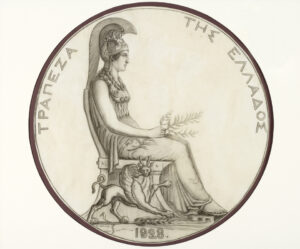
- The emblem of the Bank of Greece, designed by Michael Axelos. Collection No. 747. Goddess Athena seated on an archaic chair (klismos), wearsanAttic helmet and holdsan olive branch, a symbol of peace. Next to her, the mythical griffin, considered in antiquity as a custodian of gold and treasures

-
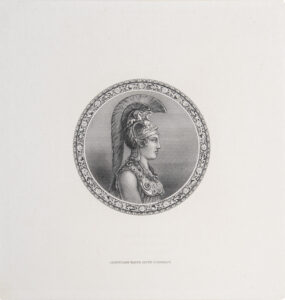
- Vignette made by the ABNC based on the emblem of the Bank of Greece for the 5,000-drachma banknote. Collection No. GRIATEA1S12Y7F80 (under processing)

-

- Obverse of the 500-drachma banknote. Collection No. 1976/60436. On the right, a detail of thedecorativebackground, formedby a weaved “security ornament”, wherein the tradename of the Bank of Greece (in Greek) is repeated in small print

The design approach evident in earlier numismatic creations by Michael Axelos, as well as his consistency in the selection of iconographic themes and supplementary decorative elements are clearly visible in the two banknotes of the Bank of Greece. The 5,000-drachma note follows the Byzantine style: On the obverse, instead of a framework, two pillars from the churchof Hagia Sophia support an architrave bearing a Byzantine ornament. On the reverse, both the central vignette featuring a mythical griffin and the decorative pattern that runs along the four sides of the banknote are also in the Byzantine artistic style.
The design of the 500-drachma banknote is of “Creto-Mycenaean style”. The central illustration on the reverse side features the decoration on the Vapheio Cup, a masterwork representation of the capture of three bulls, dating back to the early 15th century BC. On the obverse, the supplementary ornamental designs on which the two numbers “500” are engraved, indicating the value of the banknote, are Minoan in style. Similarly, the circular frame surrounding Athena on the obverse and the multi-coloured border on the reverse of the banknote echo Mycenaean decorations.
-

- Reverse of the 500-drachma banknote. Collection No. 1976/60436. The central illustration featuresthe decoration of the Vapheio Cup.It depicts the capture of three bulls with a net and the injury of their two hunters

-

- One of the two gold cups found inside the undisturbed royal tholostomb ofVapheio, Laconia, in 1888. Dating back to the early 15th century BC,it is recognised as one of the most exquisite masterpieces of pre-historic Aegean metallurgy

The remaining denominations of the first issue by the Bank of Greece were put into circulation in 1936. These were the 50-, 100- and 1,000-drachma banknotes, designed and printed in Paris by the Banque de France. Their rich vibrant colours and dense floral decorations reflect the aesthetics of the era in France, while at the same time symbolising peace and prosperity and embodying the optimistic spirit of the interwar period.
The intricate plant motifs featuring foliage, winding shoots and elongated ribbons of interwoven leaves and flowers are symmetrically arranged on the surface of the banknotes, framing the central iconographic themes drawn from mythology and antiquity, but also contemporary rural life. The supplementary illustrations – subtle depictions in the background of the notes – highlight sectors of the Greek economy, such as shipping, rail transport and industry.
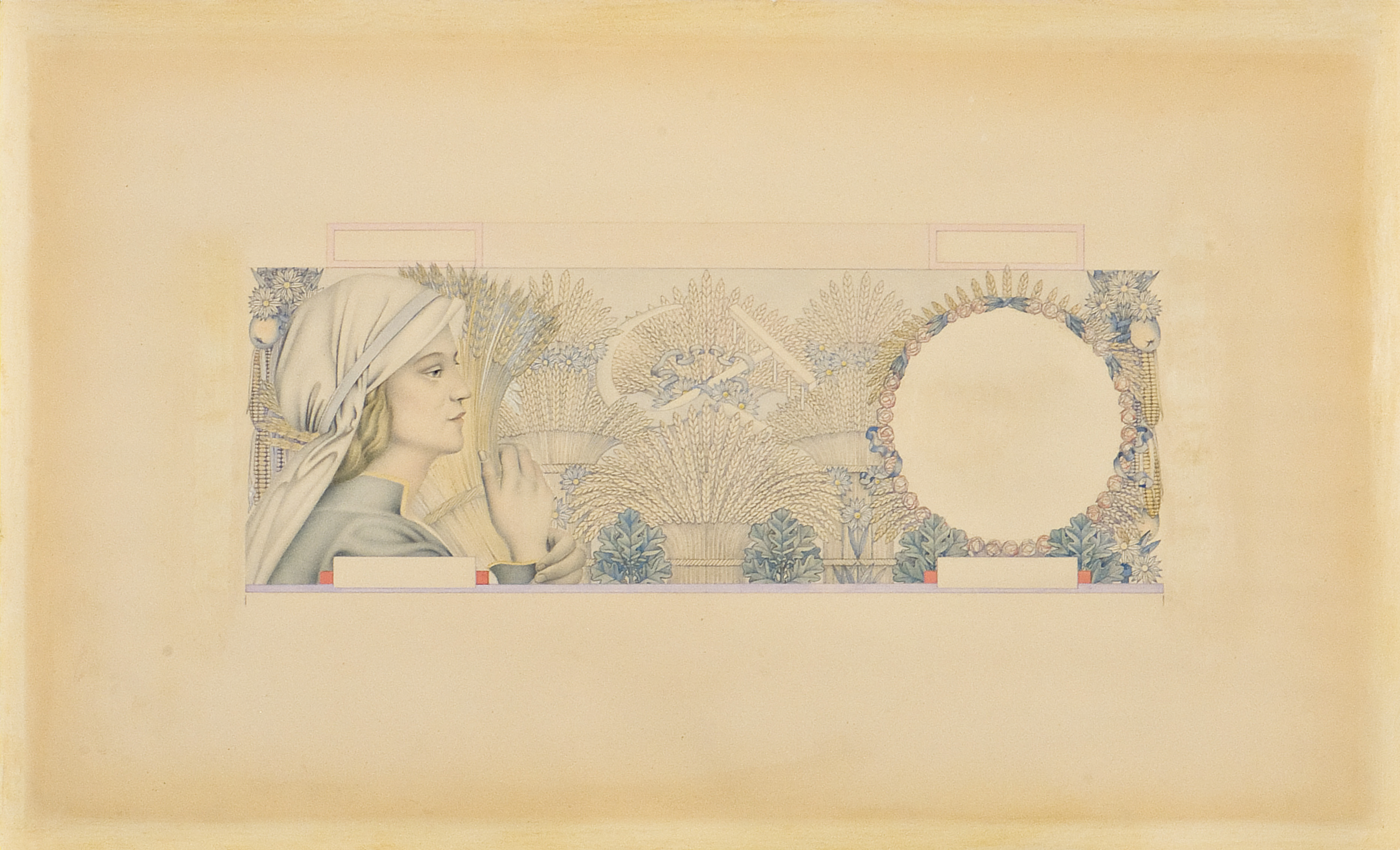
The 50-drachma banknote is dedicated to Greek agriculture. Bundles of wheat cover the background of the obverse, while the harvesting tools, a sickle and a rake, are depicted in a X-shapeat the centre. On the left, the Greek female farmer is exemplified, carrying another sheaf of wheat. The same agricultural theme is adopted on the reverse, where the central image isthe famous worshiprelief from Eleusis: Demeter, the goddess of agriculture, entrustshero Triptolemus with the sacred wheat ears to teach humans the cultivation of grains.
-
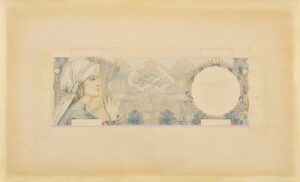
- Preliminary design of the 50-drachma banknote (obverse). Collection No. Α6. The surface of the banknote is decorated with bundles of wheat, while on the left, a modern female harvestercarries a sheaf of wheat
-

- Preliminary design of the 50-drachma banknote (reverse). Collection No. Α5.The central themefeatures the Eleusinian relief that depicts goddess Demeter presenting the sacred ears of grain to hero Triptoleums so as to teach humans the cultivation of wheat. On the right, a maiden holds a laurel branch in her left hand and a bunch of roses in her right

This inaugural issue of Bank of Greece banknotes also highlights other sectors of the Greek economy of the time. The depiction of god Hermes on the obverse of the 100-drachma banknotesymbolisescommerce. The supplementary illustration of steamships on either side alludes to shipping. On the reverse, the harvest scene with a female farmer carrying a basket full of grapes emphasises the protection of Greek interwar agriculture.
-

- Preliminary design of the 100-drachma banknote (obverse). Collection No. Α7.Hermes, the god of trade and profit, wears a winged petasos and holds a caduceus. On either side, as a supplementaryillustration, a fleet of steamships refers to Greek shipping

-
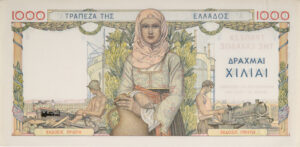
- Reverse of the 1,000-drachma banknote. Collection No.1976/60444.The“Spetsiotissa”flanked by symbolic compositions of shipping (on the left) and industry (on the right)
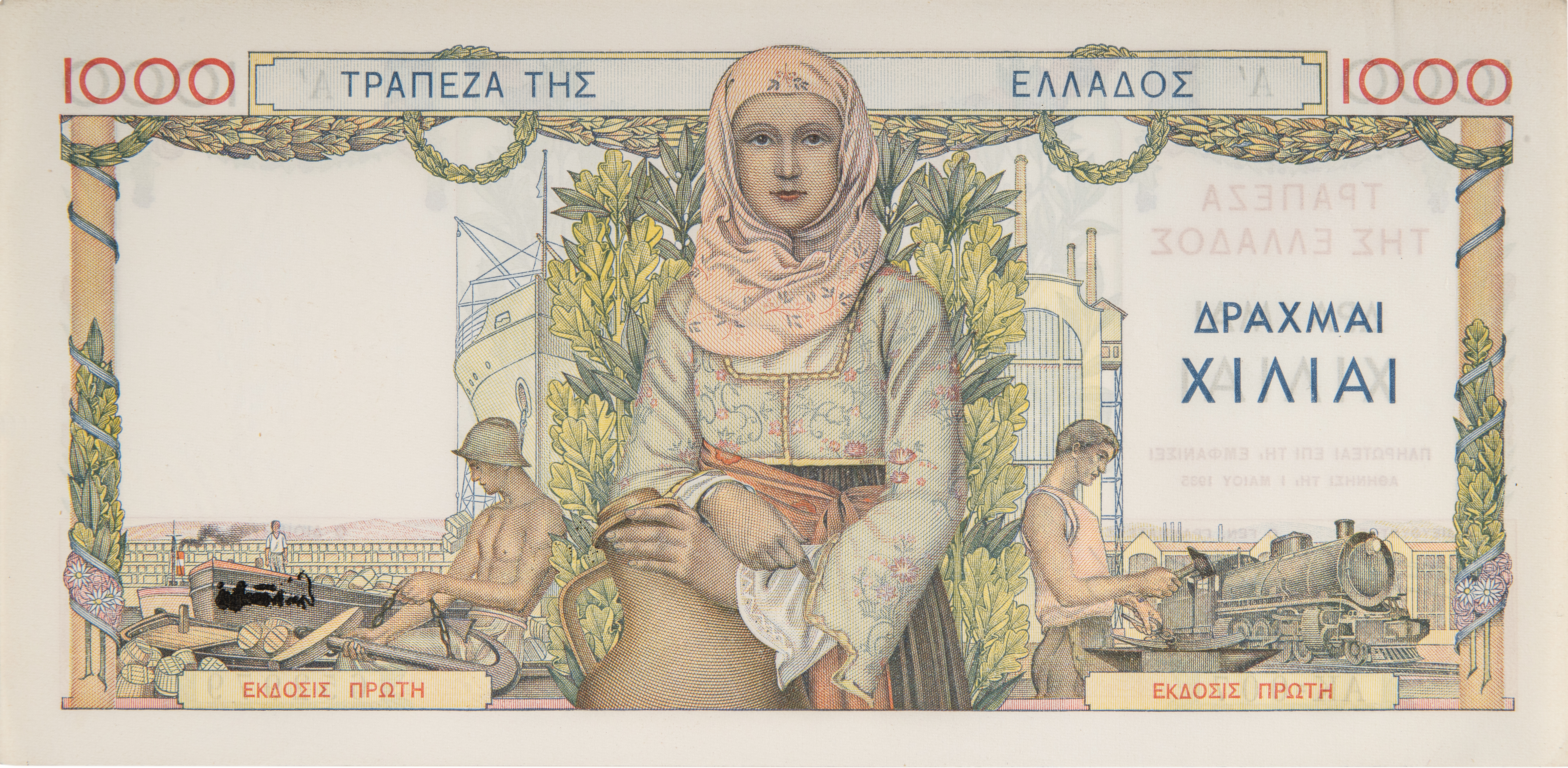
Banknotes, apart from being financial tools, also serve as carriers of national ideology, conveying state values to every citizen whouses them. The central image on both sides of the 1,000-drachma banknote features “Spetsiotissa” [woman from the island of Spetses], which evokes the nation’s cultural identity . The young womanin traditional local attire leans against a pitcher and is framed by laurel saplings. On the reverse, flanking her figure, are symbolic compositions representing shipping and industry. Two young male workers are depicted: the first, on the left, arranges the chain of an anchor, with a shipyard visible behind him; the second works on an anvil, with a factory and a steam locomotive illustrated in the background.