The banknote issuance by the National Bank of Greece

The National Bank of Greece, within the frame of exercising its issuance privilege, undertook the responsibility to produce and circulate the Greek banknotes from the commencement of its operations in January 1842 to the establishment of the central Bank of Greece in December 1927. Following this, you can draw additional information on the aspects of banknote manufacturing procedure.
The printing of the first two issues of NBG was carried out by technicians of the Bank of France. The banknotes were printed only in black ink on coloured paper. The same technique was applied to the third issue,which was produced in London with the additional feature of the watermark for the protection against counterfeiting.The following two issues marked a turning point in the printing procedure: the fourth issue, that was assigned to the “American Bank Note Company N.Y.”, introduced the implementation of polychrome printing, while the fifth issue wasprinted for the first time on both sides. For the subsequent issues NBG cooperated a new with the forementioned American company, the British companies “Bradbury, Wilkinson & Co. Ltd London” and “Waterlow & Sons Ltd London” as well as the “Staatsnoten Atelier, Wien”, the state banknote printers of the Austro-Hungarian Empire.


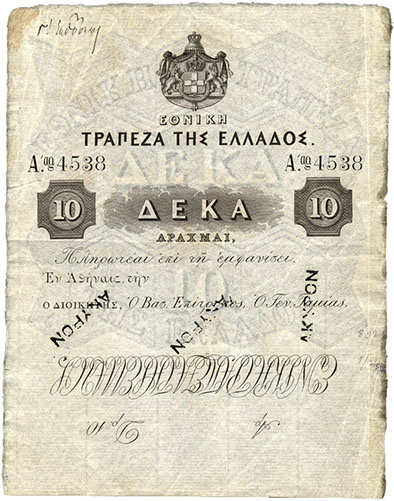
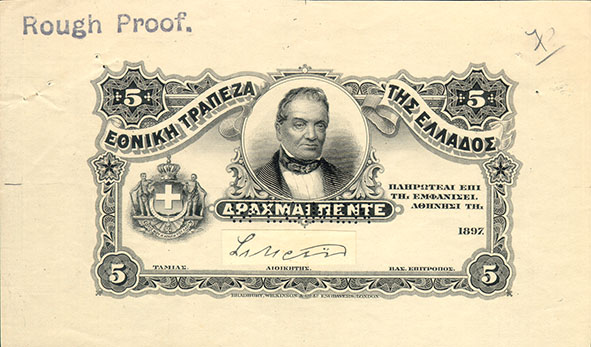
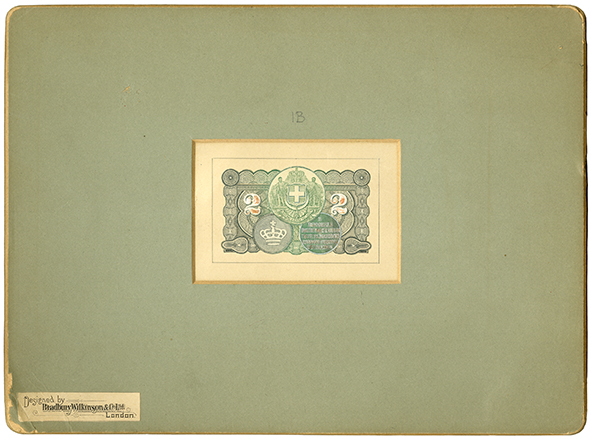
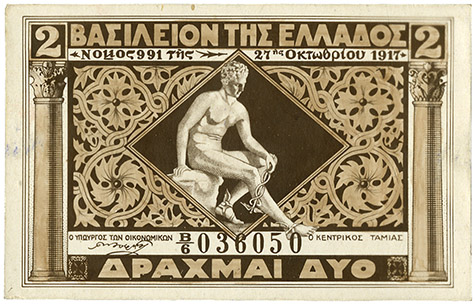
Banknote manufacturing was a complex procedure from its initial designing as a sketch and its engraving on the respective printing plate (lithograph, copper plate or steel plate) to the procurement of the appropriate paper. The Historical Archive preserves documents regarding correspondence with the manufacturers as well as samples of their work. From the second issue of NBG banknotes onwards the decorative elements are enriched with mythological and allegorical depictions, and as from the fourth issue the portrait of Georgios Stavros, the first and lifelong Governor of NBG, is incorporated in the banknote ornamentation. The decorative background, the ornaments (decorative designs) and the vignettes (ancient Greek and byzantine images) of the banknotes were selected not only on the basis of aesthetics but also by the need to signify the ideology of national continuity.


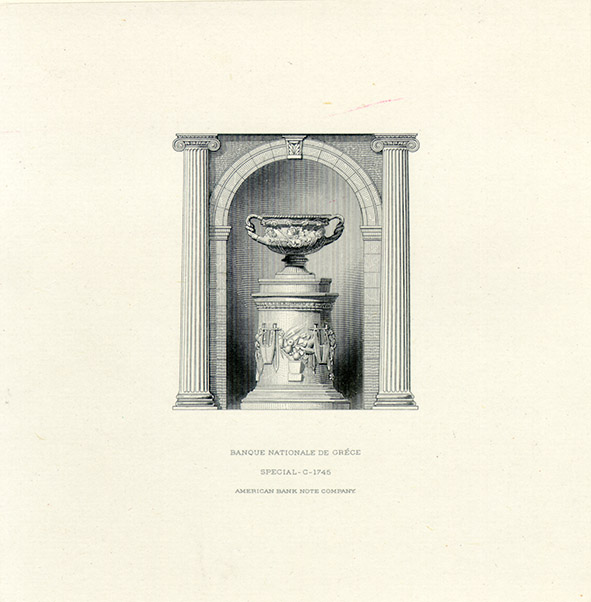
Indicative of the artistic value the National Bank of Greece attributed to its banknotes is its option to assign from 1918 onwards their image configuration to the distinguished Greek painter and engraver Michael Axelos, who continued his work in the Bank of Greece after its establishment in 1928.